Saturday, August 18, 2012


The Best Businesses Create Demand


The entrepreneur creates a model i.e. a solution to the frustrations of customers.

Adrian Slywatsky in Demand discusses necessities for successful products.
Demand creators:

1.     Make it magnetic - A product needs to appeal to our cat brain.  It needs generate emotion, or even addiction (caffeine, nicotine).  The Mac is shiny and clean. Our cat brain (limbic) makes decisions and our human brain (cerebral cortex) uses selective distortion, selective retention, and motivated reasoning to justify that decision. Our rational brain is like a lawyer making a case.  

2.     Solve hassles - The hassle map illustrates this.   On Healthcare Slywatsky discusses a successful Medicare HMO called Caremore.

3.     The backstory  - what you don’t see that makes the product work.  ITunes for the iPod is an example.

4.     Find the triggers.  What gets people to actually buy a product?  For Nespresso it is seeing a demonstration and then tasting the product. I tried this and the demonstration is impressive.

5.     Build a steep trajectory  - Keep improving the product to stay ahead of competition.   Generic capsules for Nespresso were just OK’d by a European judge

6.     De- average - segment your market.  Make tea for tea drinkers and coffee for coffee drinkers.  Know your demographics and psychographics. 


Back to Gerber’s E-myth. 

Businesses have 3 employee types.

1.  The entrepreneur focuses on how must the business work as a system for generating demand and producing results for the customer thus generating profits.  The business is viewed as a whole, modeled after a future vision.  It is less important what is done than the process of how it is done.  It’s not the commodity, but the delivery.  How does my business look to the customer?  All work must be documented in operations manuals.
 

2.  The manager organizes the technicians and maintains the status quo often engendering conflict with the changing vision of the entrepreneur.   A people strategy is developed to communicate purpose, standards, and demand accountability to and of the employees.  Gerber’s manager creates a role for the technicians  in a game. The game requires victories to keep people involved and the game can never end.


3.  The technician  - does what work needs to be done to produce results to generate income.  He looks at the business as a sum of parts modeled in the present.  Gerber says that people with the lowest level of skill to fulfill their function should operate your business.    The critical step is determining what you really need.  Using low cost employees often goes against conventional wisdom as described by Michael Lewis in his book Moneyball. 


 Gerber notes that Business depends on
Innovation -which is trying new things.
Quantification - Does wearing a different color increase sales
Everything should be quantified.  Michael Lewis describes in Moneyball how critical it is to see which factors make a difference
Orchestration- after something is found to be an improvement all discretion is eliminated. 
It is only recently that corporations have adopted this as the Lean management process.


Saturday, August 11, 2012


 Last Saturday I was supposed to meet with a group at Gas Works Park.   Looking for familiar faces, I took a walk around the park.  It was a beautiful hot (for Seattle) summer day.   There were several weddings going on.  As I hiked around the hill there were two women in their twenties sunning themselves.   I overheard one say to the other earnestly, “ Things just won’t get better until these old people die off”.    They must mean me, I thought.

Thursday, August 2, 2012


 Our Irrational Mind


Michael Gerber’sE Myth - When a customer first hears about a product until the time he is triggered to buy it several thing happen.  First the brain takes in all the information needed to make a decision. It works like this.  A + B = C.  A is the stimuli.  B is what your brain does with it. C is the action that occurs.   The most important part is B.   The stimuli may go to the conscious mind but it is the unconscious mind that makes the decision.  The cat brain (see below) decides.   The unconscious mind contains the customer’s expectations.   These make up his personality.   If the food meets expectations the mind says yes.   The unconscious mind sends its decision to the conscious mind, which then goes out to the world to assemble the rational armament to support its already determined emotional commitment.   Therefore, buying decisions are made irrationally.
The  demographics (who your customer is ) establish the psychographics ( why he buys).   Reality exists only in someone’s perceptions.   Thus to create demand you need to find a perceived need and fill it. 


You have 3 brains.

 The most primitive is the reptile brain.  This does most of the housekeeping such as breathing, heart rate, sleeping, waking.   It also takes in visual signals and keeps track of your position in a room.  That, this is done in a separate part of the brain from the rest of visualization  is how you can drive home, have no memory of driving, and yet arrive alive.   The reptile brain got you home.

On top of that is a cat brain.  This manages animal survival.   Most of its functions involve the 4 Fs – fighting, feeding, fleeing  and ... reproduction.   Its  amygdala signals the emotions of the Fs  rage, pleasure, fear and their memories.  The amygdala  attaches to the hippocampus which converts short term memories to long term.  This is why you remember things that are emotionally charged.   These structures surround an egg shaped thalamus which is a control tower for the senses. 

When you first walk into a room your reptile brain notes your position. Then your cat brain scans the room.   You notice if there is anything you can eat.  ?  Is there anything that will eat you?   Is there anything you can mate with.  Is there anything that will mate with you .  Is there anything you have seen before. 

Finally covering this like a baby blanket is the neocortex.  Although it appears uniform , each region of this is specialized with regions for speech, vision,  memory etc.  The part behind the forhead, prefrontal cortex, handles the uniquely human “executive functions” problem solving, maintaining attention, and inhibiting emotions (leashing the cat).  Since the birth canal can only be so big, babies are born with an undeveloped brain.  Thus babies are learning machines making adults teachers.   


Which leads to Brain Plasticity 


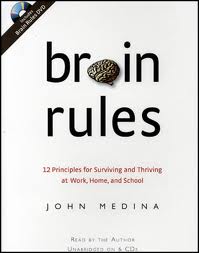
Medina Baby Brain Rules Lecture at Google

The brain is a plastic machine.  The brain  establishes control of its development. 

 The first stage consist of  anything goes plasticity.  For example if exposed to specific sounds the brain develops an auditory cortex or a language specific processor.  If exposed to random noise this does not happen.   Through natural competitive plasticity processes the brain organizes itself to learn language.   A the baby gets exposed to 4 million words before it puts meaning to any words at about 9 months.   This is important to developing working memory and selective attention.  In the next stage plasticity only occurs when the brain interprets an outcome as good for it.   As we age learning  gets more gates and the brain selects what it wants to learn.   It evolves to where it can control its self -development. 

Merzenich  then covers the example of a child learning to use a spoon.  The brain specializes by evaluating the success of an attempt.  If the attempt is good the brain says save it and it strengthens the connections that made that attempt.   Over thousands of attempts, it evaluates, judging by success in getting the food.  It creates a model of a good attempt in memory and  evolves a model by practicing its use.  It  then evaluates its success against that model.   The area of the cortex devoted to controlling the hand gets larger and millions of neurons interconnect differently.   That’s how you master abilities and finally develop what is YOU.   All input is associated with all previous plasticity, which is your model of the world; your prediction of what comes next - You.  You compare every input with your prediction.  This happens billions times a year and becomes you.

In a second stage  it acquires it primary skills.  This is done at school and life


Lastly in the third stage  it becomes a user of skills it has mastered which gets us through most of our life.  

 You can screw up a brain with bad genetics, a bad childhood.  However, since the brain  is plastic it can be fixed.


Thursday, July 19, 2012


Tabloid Journalism works like Cocaine

Stephen Denning TED talk

Sunday, July 15, 2012


End of Life (EOL)

My father lived to be 90.  In his last years, he realized he had Alzheimer’s and this  frustrated him, since his mind had always been sharp.     He became frail and would be admitted to the hospital, where he would improve and then be transferred to a rehab facility.  He would stay there for several months, and then recover enough to go home.   He was able to stay at home with the help of a caregiver, who came during the day.  After six months, he moved to an assisted living facility to be closer to family.   There again, he was admitted to the hospital, then transferred to rehab, and then back to assisted living.  After several cycles of this he became tired.   He wanted to be with his wife.  At that time we were unaware that we could request that he not be sent to the hospital.    By the last cycle it was clear he did not want to go to the hospital.   Hospice was arranged to take care of him.   Our experience was that the only way to die at home is through hospice. 

He did very little EOL planning.   People plan their vacations more than their EOL


Katherine Foley, MD on EOL

Mary Catherine Bateson on EOL    (Margaret Mead's daughter)

Sunday, July 8, 2012


This book illustrates how to develop a market.   Markets go through stages and each stage of the market requires a different selling strategy.  When the first small computers came out it was visionaries who bought them because their function was very limited.  I remember before Bill Gates created software they were a box with blinking lights.  The competition was the existing technology.  People don't need new device as they have been getting along without it. The first customers of a new technology are the few forward thinking people who can see the opportunity.  To sell to them you need "a closer". Closing is when the sale becomes a fact. Achieving this requires the customer to feel desire for the product or fear of loosing the product.  Closers excel at this, however they can be unethical as they are strictly motivated by the sale.  As the market grew, it expanded to include the progressive customer who saw the value but wanted to buy the whole solution and needed technical help.  At this point, "sales wizards" are vital to offer a solution. They hold the customers hand and make the technology work for the customer.  The military now practices "system buying".   A company at this point in the markets expansion needs to make a choice whether to become a technology company and advance the technology while keeping its sales staff of "closers" and "wizards" or whether to follow the market and sell a standardized product to knowledgeable users.   No company can be all things to all customers. He doesn't buy Tushman's "The Ambidextrous Organization".   A company must choose the customers for whom it can deliver the most value.   Advancing the technology can lead to companies that are very profitable but not huge.  Then, if a company goes after the market, it must choose weather to dominate a market niche or go after the mass market.  To sell to a growing market takes "relationship builders".  Think the old IBM.   Finally, To sell to  a global mature market one needs not great sales people but a great sales system managed by a "sales captain".   Sales will be by kids such as those in Best Buy or The Apple Store. In a mature market improvements will be evolutionary because standards need to be maintained. At this point a customers two main reason for not buying are price and hassle.  Therefore your strategy is to lower price and make things easier for the customer.   To manage staff the captain makes games and contests out of who does the best with the most challenging customers.  This may be the best marketing book you haven't read.

In summary  

Technology
  birth   
  fast growth  
  incremental growth
   maturity
Customers
  gateswingers  
  progressive
   relationship  
  the world
Sales people
  closer  
  wizard  
   relationship builder
   captain and crew
Strategy
  build the dream  
 use knowledge to create custom solutions
   be your customers strongest ally
  make it easy to buy and price it low 
Selling approach
 high - energy evangelical enthusiasm  
  professional smooth
 warm friendly long term relation
helpful courteous efficient
Service 
 refund if a problem
  total support
  advocate for your customer
  consistent quality and low prices  

 The Nine steps of selling 

Marketing

1 Marketing communications  - building an image to induce attention
2 Generating leads -  contacting people who might become customers
3 Qualifying Prospects  - finding people with the means to buy from you 
Sales 
4 Presentation  - the sales persons pitch
5 Resolving objections - remove the barriers to the sale
6 Closing the sale  - persuading customers to say yes
Service
7 Execution and Service  - managing to keep the customer satisfied now and later
8 Building relationships  - personal contacts that take place after the sale
9 Repeat business - the pot of gold

This book was an update of his book, "The Quadrant Solution".  Jeff Cox also co wrote "The Goal".  We went to a start-up conference two weeks ago and the lawyer said the biggest legal mistake new entrepreneurs make is not signing with their middle initial.  The next was not clarifying who owns what.  The point is do everything in writing and make it legal as demonstrated by this story in Jeff Cox Blog .

Sunday, July 1, 2012


Hierarchical Temporal Memory is a model of how the brain works which was developed by Jeff Hawkins of Palm Pilot fame.  It is  known that synapses form rapidly.  One has to learn things multiple times to stimulate synapse development to store knowledge.  The brain recognizes patterns in 4 dimensions (including a temporal dimension).   That is how we predict future states and why we enjoy music.  

The hippocampus is an old area of the brain connected to the neo-cortex short term storage that is vital for learning.  As you see the world most of the states immediately go away.  The hippocampus quickly stores patterns until they can be implanted deeper in the brain.  It’s a way of remembering at the moment.  Without it every day would be Groundhog Day.  

 
 Jeff Hawkins 2003 Ted Talk with his predictions for AI

Where we are now.

Jeff Hawkins speaking at UBC in 2010
Jeff Hawkins 10 minute talk 2011 at MIT
Jeff Hawkins speaking in 2012
Google milestone 
16000 processors teach themselves to recognize a cat
Numenta : This is used commercially
Check out Vitamin D freeware